1. Basic Information
| Particular | Details |
|---|---|
| University Name | Swami Ramanand Teerth Marathwada University |
| Common Name | SRTM University / SRTMUN |
| Established | 17 September 1994 |
| Type | State Public University |
| Location | Vishnupuri, Nanded, Maharashtra |
| Address | Dnyanteerth, Vishnupuri, Nanded – 431606 |
| Jurisdiction | Nanded, Latur, Parbhani and Hingoli |
| Recognition | UGC 2(f) and 12(B) |
| NAAC Accreditation | B++ Grade |
| NAAC CGPA | 2.96 |
| University Campus | Vishnupuri, Nanded |
| Latur Sub-Campus | Peth, Latur |
| Parbhani Sub-Campus | Parbhani |
| Constituent College | New Model Degree College, Hingoli |
| Affiliated Colleges | 402 for 2024–25 |
| Official Website | srtmun.ac.in |
The university’s official profile confirms its establishment on 17 September 1994, UGC recognition under Sections 2(f) and 12(B), and NAAC re-accreditation with B++ grade and CGPA 2.96. Its current affiliation data lists 402 affiliated colleges for 2024–25.
2. Location & Campus
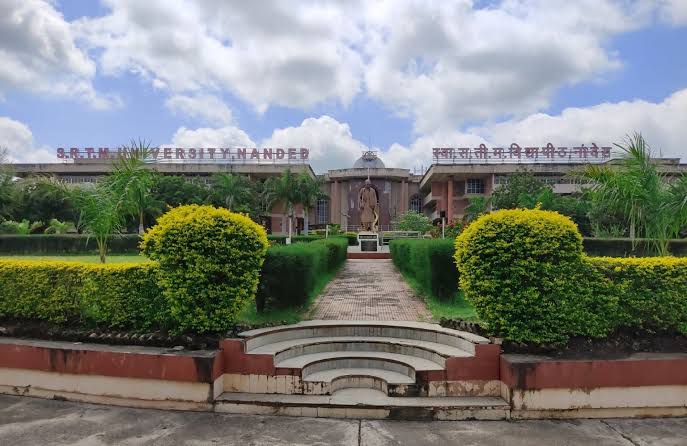
The main campus of Swami Ramanand Teerth Marathwada University is located at Vishnupuri in Nanded, on the banks of the Godavari region of southern Maharashtra. The university is an important centre for higher education, research and innovation in Marathwada.
The university has developed beyond its original Nanded campus. Its academic network currently includes 13 schools at the Nanded campus, schools at the Latur sub-campus, a sub-campus at Parbhani and New Model Degree College at Hingoli.
The Latur Sub-Campus is located at Peth on the Latur–Ausa Road, approximately 5 km from Latur city. Current university information identifies academic activity there in management, technology and social sciences, while the sub-campus also has supporting library and student facilities.
3. Admission Information
SRTM University admissions vary according to the programme. The university offers admissions to undergraduate, postgraduate, professional and research programmes through its university schools and constituent institutions, while affiliated colleges conduct admissions for their respective programmes.
The university maintains an Online Admission facility and publishes programme-specific eligibility, intake and admission information. Some postgraduate programmes use a Common Entrance Test (CET). For example, the M.A./M.Sc. Mathematics and Statistics programmes at the School of Mathematical Sciences specify CET-based admission.
Students should generally:
- Check the eligibility criteria for the selected programme.
- Register through the appropriate university admission portal.
- Appear for CET or another entrance examination wherever applicable.
- Follow merit-list or selection procedures.
- Complete document verification.
- Pay the prescribed fees within the admission deadline.
For 2026–27, students should rely on the latest programme-specific university notifications because admission rules, eligibility and intake can differ between courses.
4. Undergraduate Programmes
SRTM University offers undergraduate programmes through its university schools and constituent institutions, while a much larger range of undergraduate courses is available through its affiliated colleges.
Current university-level undergraduate offerings include programmes such as:
- B.Com.
- BBA
- B.Pharm.
- B.Sc. and science-related programmes
- Computer and computational science programmes
- Technology-oriented programmes
- Other multidisciplinary undergraduate programmes under the NEP framework
The university’s current undergraduate education page lists four-year B.Com. and BBA programmes, with BBA having an intake of 60 at the university level.
The School of Pharmacy offers B.Pharm., with the university listing an intake of 60 and admission according to the applicable Maharashtra government/DTE norms.
Students should distinguish between programmes offered directly by SRTMUN and programmes offered by its 400+ affiliated colleges.
5. Postgraduate Programmes
Postgraduate education is one of the strongest components of SRTM University. Its schools cover science, technology, humanities, commerce, management, pharmacy, media, languages and social sciences.
Science & Technology
Major postgraduate areas include:
- M.Sc. Physics
- M.Sc. Chemistry
- M.Sc. Mathematics
- M.Sc. Statistics
- M.Sc. Computer Science
- M.Sc. Biotechnology
- M.Sc. Microbiology
- M.Sc. Botany
- M.Sc. Zoology
- M.Sc. Geology
- M.Sc. Environmental Science
- M.Sc. Geophysics
- M.Sc. Electronics
- M.Sc. Energy Studies
- M.Pharm.
- Technology and engineering-related programmes
For example, the School of Physical Sciences offers M.Sc. Physics and M.Sc. Energy Studies, while the School of Pharmacy offers M.Pharm. specialisations including Pharmaceutics, Pharmaceutical Chemistry, Pharmacology and Quality Assurance.
Humanities & Social Sciences
Postgraduate programmes include areas such as:
- M.A. Marathi
- M.A. English
- M.A. Hindi
- M.A. Urdu
- M.A. Economics
- M.A. History
- M.A. Political Science
- M.A. Sociology
- M.A. Public Administration
- M.A. Philosophy
- M.A. Geography
- M.A. Social Work
- M.A. Mass Communication & Journalism
The university also has dedicated schools for languages, social sciences, media studies and educational sciences.
Commerce & Management
- M.Com.
- MBA
- Management Science programmes
- Commerce-related postgraduate programmes
Media & Library Science
The School of Media Studies offers:
- M.A. Mass Communication & Journalism
- M.Sc./M.A. Electronics Media Studies
- Master of Library & Information Science
The current university course information lists these programmes along with their duration and eligibility requirements.
6. Ph.D. / Research Programmes
Research is a major part of SRTM University. The university maintains Ph.D. programmes across its four broad faculties:
- Science & Technology
- Humanities
- Commerce & Management
- Inter-disciplinary Studies
Current Ph.D. programmes at the university include research in:
Science & Technology
- Biotechnology
- Bioinformatics
- Botany
- Chemistry
- Computer Science
- Environmental Science
- Geology
- Geophysics
- Mathematics
- Microbiology
- Physics
- Statistics
- Zoology
- Pharmacy
- Civil Engineering
- Computer Science & Engineering
- Electronics & Telecommunication Engineering
- Instrumentation Engineering
- Mechanical/Production Engineering
- Textile Technology
Humanities
- Marathi
- Hindi
- English
- Urdu
- Law
- Sociology
- Geography
- History
- Economics
- Political Science
- Public Administration
- Philosophy
Commerce & Management
- Commerce
- Management Science
Interdisciplinary Studies
- Education
- Physical Education
- Library & Information Science
- Social Work
- Mass Communication & Journalism
The university’s current Ph.D. programme list confirms research opportunities across these schools and disciplines.
7. University Departments & Academic Areas
SRTM University currently operates through a broad school-based academic structure.
The major schools at the Nanded campus include:
- School of Chemical Sciences
- School of Commerce & Management Sciences
- School of Computational Sciences
- School of Earth Sciences
- School of Educational Sciences
- School of Fine & Performing Arts
- School of Language, Literature & Culture Studies
- School of Life Sciences
- School of Mathematical Sciences
- School of Media Studies
- School of Pharmacy
- School of Physical Sciences
- School of Social Sciences
The university also has specialised academic centres and facilities including the Central Instrumentation Centre, Women’s Study Centre, Skill Development Centre and Dr. Babasaheb Ambedkar Chair & Study Centre.
At the Latur Sub-Campus, current academic schools include:
- School of Management
- School of Technology
- School of Social Sciences
The university’s current contact information also identifies the Latur sub-campus’s academic structure.
8. Campus & Facilities
SRTM University provides facilities supporting academic learning, research, residential life and student development.
Major facilities and initiatives include:
- Central library
- Departmental libraries
- Laboratories
- Central Instrumentation Centre
- Computer and digital learning facilities
- Hostels
- Sports facilities
- Skill Development Centre
- Women’s Studies Centre
- Research and innovation facilities
- Seminar and conference facilities
- Student support services
- NSS and extension activities
- E-learning and digital academic resources
The university’s campus prospectus specifically identifies the Central Instrumentation Centre, Women’s Study Centre and Skill Development Centre as important components of the Nanded campus.
The Latur sub-campus also has a central library with reading facilities, e-journal access through INFLIBNET and dedicated facilities for competitive examinations and distance education.
9. Affiliated Colleges / Student Life / Career Opportunities
Affiliated Colleges
SRTM University has a substantial affiliated-college network covering four districts:
| District | Colleges |
|---|---|
| Nanded | 142 |
| Latur | 134 |
| Parbhani | 83 |
| Hingoli | 43 |
| Total | 402 |
The university’s official 2024–25 affiliation data lists 402 affiliated colleges, including 2 government colleges, 99 private-aided colleges, 301 private-unaided colleges and 1 constituent college. It also lists 2 autonomous colleges.
The affiliated network covers a wide range of disciplines:
- Arts
- Commerce
- Science
- Computer Applications
- Education
- Engineering & Technology
- Fine Arts
- Law
- Management
- Journalism & Mass Communication
- Pharmacy
- Sanskrit
- Vocational education
- Architecture
- Hotel & Tourism Management
The university’s current affiliation data lists 183 Arts, 162 Science, 121 Commerce and 103 Computer Application colleges, among other categories.
The university is actively updating affiliation-related information for 2026–27 and 2027–28, so Admission Katta should treat the 402 figure as the latest consolidated published 2024–25 figure rather than presenting it as a live 2026 number.
Student Life
Student life at SRTM University combines academic activities with research, sports, cultural activities, social outreach and skill development.
Students can participate in:
- NSS
- Sports and physical education
- Cultural activities
- Research projects
- Seminars and conferences
- Innovation activities
- Skill-development programmes
- Women’s Studies initiatives
- Social and community-development activities
The university’s multidisciplinary structure gives students opportunities to interact across science, technology, humanities, commerce and social-science disciplines.
Career & Placement Opportunities
Career opportunities vary according to the programme and institution. Students in computer science, engineering, pharmacy, management, commerce, biotechnology, media and other professional areas can pursue opportunities in industry, services, research, education, government and entrepreneurship.
The university also has a Training & Placement-related coordination structure, with faculty members involved in placement and student development activities. Its Skill Development Centre further supports practical and employability-oriented learning.
For Admission Katta, placement information should be maintained college-wise and course-wise wherever verified data is available, rather than attributing the placement performance of an affiliated college directly to SRTM University.
Maps
Photos