
1. Basic Information
| Information | Details |
|---|---|
| University Name | D Y Patil International University (DYPIU) |
| Location | Sector 29, Akurdi, Pune, Maharashtra – 411044 |
| Established | 14 March 2018 |
| University Type | State Private University |
| Established Under | Maharashtra Act No. LXIII of 2017 |
| Recognition | UGC recognized State Private University |
| Academic Model | Multidisciplinary, school-based university |
| Major Academic Areas | Engineering, Computer Science, Management, Biotechnology, Design, Fine Arts, Media, Liberal Arts, Economics, Forensic Science and emerging technologies |
| Campus | Akurdi, Pune |
| Admission Status | Admissions open for 2026 |
| Official Website | dypiu.ac.in |
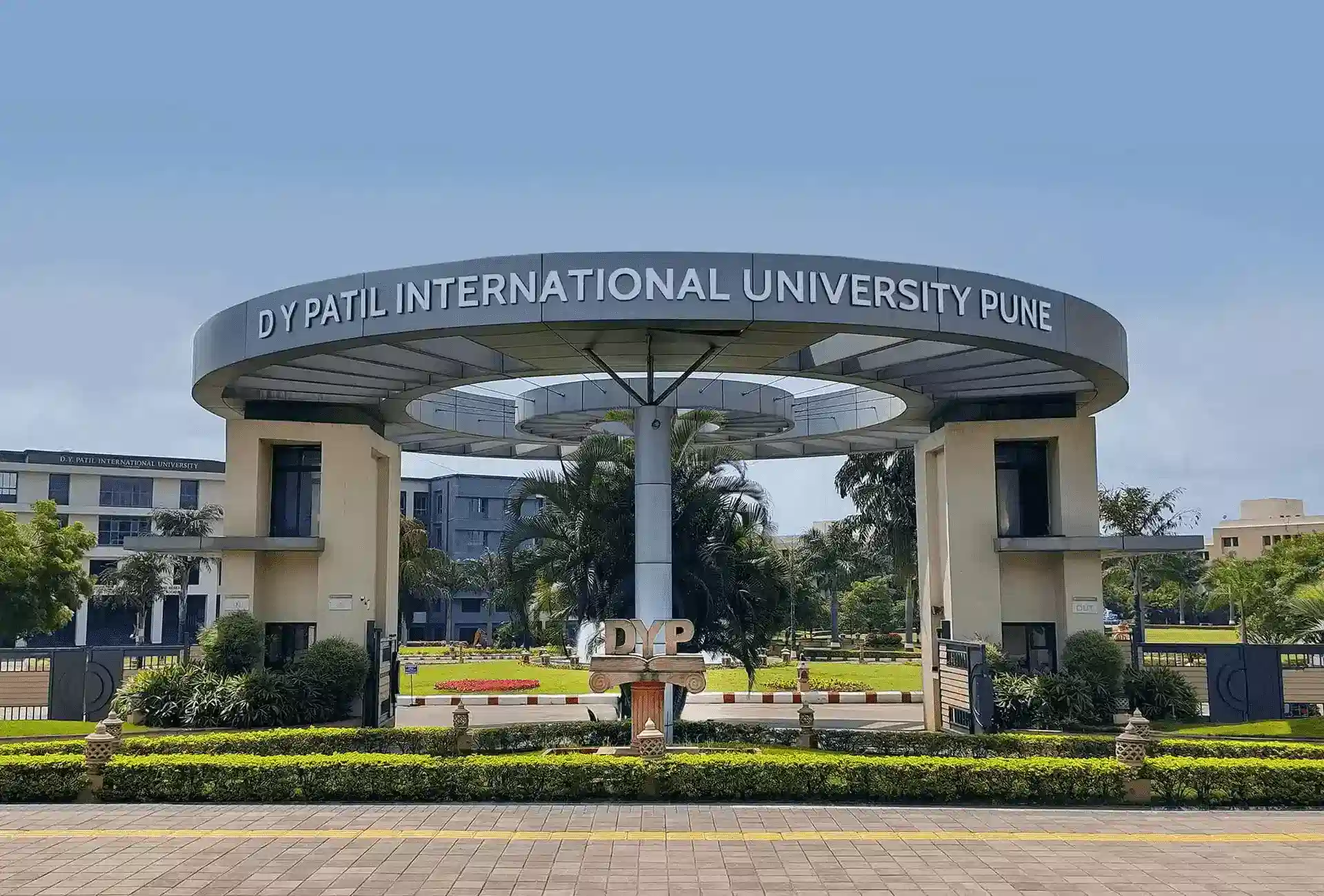
D Y Patil International University was established on 14 March 2018 and operates as a State Private University in Maharashtra. The university is located at Akurdi in Pune and offers undergraduate, postgraduate and doctoral programmes across technology, engineering, management, design, sciences, media and liberal arts.
2. Location & Campus
D Y Patil International University is located in Sector 29, Akurdi, Pune, within the wider D. Y. Patil educational ecosystem. Akurdi is a well-connected part of the Pune metropolitan region and is known for its educational institutions and proximity to major industrial and technology areas.
The university follows a multidisciplinary academic model, with programmes spread across engineering, computer science, management, design, applied sciences, media, humanities and emerging technology areas.
The campus includes academic laboratories, research facilities, library resources, student facilities and hostel accommodation. DYPIU’s current campus infrastructure also includes specialised facilities for computing, AI, cybersecurity, robotics, biotechnology, advanced manufacturing and 3D printing.
3. Admission Information
DYPIU is currently accepting applications for 2026 admissions across undergraduate, postgraduate and Ph.D. programmes. The university’s current admission portal lists programmes including B.Tech, BCA, BBA, B.Design, BFA, BA Liberal Arts, BA Journalism & Mass Communication, B.Sc Economics, B.Sc Forensic Sciences, MBA, MCA, M.Sc programmes and Ph.D.
The general admission process includes:
- Online registration
- Filling the application form
- Uploading eligibility documents
- Payment of the application fee
- Eligibility/document verification
- University entrance examination or programme-specific selection process
- Personal interview wherever applicable
- Provisional admission offer
- Payment of admission/first-semester fees
- Physical verification of original documents
- Final admission confirmation
The university’s current admission procedure states that the application fee is ₹1,000 and that eligible applicants may be required to appear for the DYPIU Entrance Test and/or Personal Interview depending on the programme.
For example, B.Tech CSE eligibility currently requires 10+2 with Physics and Mathematics along with one of Chemistry, Computer Science, Electronics or Information Technology, with the prescribed marks requirement. Candidates can qualify through examinations such as MHT-CET, JEE, other recognised state/national engineering entrance examinations, PERA or the DYPIU entrance test.
Important: Admission criteria vary by programme, so students should check the specific eligibility and selection process before applying.
4. Undergraduate Programmes
DYPIU offers undergraduate programmes across technology, engineering, management, sciences, design, media and humanities.
Engineering & Technology
- B.Tech Computer Science & Engineering
- B.Tech CSE – Artificial Intelligence & Machine Learning
- B.Tech CSE – Cyber Security & Forensics
- B.Tech Chemical Engineering
- B.Tech Civil Engineering
- B.Tech Mechanical Engineering
- B.Tech Mechanical Engineering with AI & ML
- B.Tech Semiconductor Engineering
- B.Tech Bioengineering
The university has also introduced emerging technology-oriented offerings such as AI/ML, cybersecurity, semiconductor engineering and advanced computing.
Computer Applications
- BCA (Hons.)
Commerce & Management
- BBA (Hons.)
Science
- B.Sc Economics (Hons.)
- B.Sc Forensic Sciences (Hons.)
Design & Fine Arts
- B.Design
- Bachelor of Fine Arts (BFA)
Humanities & Media
- B.A. Liberal Arts (Hons.)
- B.A. Journalism & Mass Communication (Hons.)
These programmes reflect DYPIU’s expansion beyond conventional engineering education into multidisciplinary and emerging career areas.
5. Postgraduate Programmes
Current postgraduate programmes include:
Engineering & Technology
- M.Tech Computer Science & Engineering – Quantum Computing
- M.Tech Smart Manufacturing
Computer Applications
- MCA
Management
- MBA – Digital Business
- MBA – Executive
Science
- M.Sc Computational Mathematics
- M.Sc Medical Biotechnology
- M.Sc Medicinal Chemistry
Media & Communication
- M.A. Journalism & Mass Communication
The university’s 2026 programme information indicates a growing focus on areas such as quantum computing, computational mathematics, medicinal chemistry and digital business.
6. Ph.D. / Research Programmes
DYPIU offers Ph.D. programmes and has established a dedicated research ecosystem supporting interdisciplinary research.
The university’s Research and Development Cell coordinates research activities and works with faculty, students, funding agencies, industry and regulatory bodies.
Research infrastructure covers areas including:
- Computer Science
- Artificial Intelligence
- Data Science
- Cybersecurity
- Robotics
- Bioengineering
- Biotechnology
- Chemistry
- Physics
- Mathematics
- Advanced Manufacturing
- Quantum Computing
- Interdisciplinary sciences
- Design and social sciences
The Centre for Interdisciplinary Studies and Research is intended to bring together science, technology, design, economics, humanities and social sciences for collaborative research. Its initial research areas include computational drug design, medicinal chemistry, synthetic chemistry, quantum materials, quantum computation, physics and mathematics.
DYPIU also operates a Centre for Innovation, Incubation & Entrepreneurship (CIIE) to support student and faculty innovation, entrepreneurship, mentoring, incubation and startup development.
7. University Departments & Academic Areas
DYPIU has adopted a school-based academic structure rather than the traditional affiliated-college model.
Major academic schools and areas include:
- School of Computer Science, Engineering & Applications
- School of Engineering, Management and Research
- School of Commerce and Management
- School of Design
- School of Media and Communication Studies
- School of Applied Arts & Crafts
- School of Humanities & Social Sciences
- Bioengineering and Biotechnology
- Applied Sciences
- Research and interdisciplinary studies
The School of Engineering, Management and Research currently focuses on Chemical, Civil, Mechanical, Semiconductor and Mechanical Engineering with AI & ML, with hands-on facilities including CNC/VMC machining, robotics, 3D printing and metrology laboratories.
8. Campus & Facilities
DYPIU provides facilities intended to support both academic learning and student life.
Library
The university’s Learning Resource Plaza / Central Library is located in J Block and covers approximately 278.7 sq. metres. It includes reading areas, Wi-Fi, RFID-based security and self-check-in/check-out facilities, along with digital and academic resources.
Laboratories & Research Infrastructure
The university has specialised laboratories for:
- Artificial Intelligence
- Data Science
- Cybersecurity
- Robotics
- Computer Networks
- Embedded Systems
- Signal Processing
- Brain–Computer Interface
- Biotechnology
- Bioengineering
- 3D printing and bioprinting
- Advanced manufacturing
- CNC/VMC machining
- Additive manufacturing
The research infrastructure includes more than 500 computer systems across five programming computer laboratories, along with specialised biotechnology and manufacturing equipment.
Hostel
DYPIU provides D Y Patil Residency for male and female students. The hostel includes single and multiple-bed rooms, attached washrooms, indoor sports facilities, gym, dining hall, reading room, TV room and a shopping area.
Innovation & Entrepreneurship
The university’s CIIE provides incubation facilities, mentoring, industry exposure, investor connections and startup support for students and aspiring entrepreneurs.
9. Affiliated Colleges / Student Life / Career Opportunities
Affiliated Colleges
DYPIU is a State Private University and follows a school-based academic structure. It should therefore not be presented on Admission Katta as a conventional affiliating university with a large network of affiliated colleges.
For the Admission Katta database, the preferred structure would be:
D Y Patil International University → School → Programme → Specialisation → Eligibility → Entrance → Fees → Admission → Facilities → Placement
This will make the university page substantially more useful for students than simply showing an affiliated-college count.
Student Life
Students have access to hostel accommodation, sports facilities, library resources, laboratories, innovation activities and academic/research centres. The university also provides opportunities through its entrepreneurship and incubation ecosystem.
Career & Placement
DYPIU has an Office of Career Services / Placement and states that campus placement assistance is available for eligible students.
For Admission Katta, placement information should ideally be maintained programme-wise, including:
- Average package
- Highest package
- Placement percentage
- Major recruiters
- Internship opportunities
- Programme-wise placement data
These figures should be added only when supported by the university’s latest official placement report rather than using promotional numbers without context.
Maps
Photos